
Visiting Flanders Fields: Ypres, the Menin Gate and the Places Beyond the Railway
At 8:00 pm, every evening, buglers step under the Menin Gate in Flanders Fields and play the Last Post. They’ve done it almost every night for close to a hundred years. Some people come for the ceremony. A lot of them come for one name on the wall.
Here’s what most guides don’t tell you: Ypres itself is only the starting point. The cemeteries people cross the world for are out in the fields, kilometres apart, and the train stops at the station. The ceremony ends around 8:30 pm. The buses, by then, have mostly given up for the day.
So this guide covers the part that actually needs planning. What to see, how to get between places that were never designed to be visited together, and how to find one particular name.
Getting to Ypres (Ieper)
From Brussels the train takes about two hours, usually with a change at Kortrijk. Driving is faster, a good hour and a half, and from Bruges or the coast you’re looking at about an hour.
Quick naming note before you buy anything: Belgian departure boards say Ieper, not Ypres. Same city. Ypres is just the English and French spelling, and it confuses people at the station every single day.
Coming from the UK? Most people route through Brussels first (our guide to travelling from London to Brussels covers that leg). If you’re flying in for the Last Post or a Remembrance anniversary, though, be honest with yourself about the connections. Airport, train, change at Brussels, change again, luggage the whole way. That’s the situation where a transfer straight from Brussels Airport earns its money: no train changes, straight to Ypres.
Ypres itself is small. You’ll walk everywhere. The problem starts outside town, where Tyne Cot, Langemark and Essex Farm sit in three different directions and the bus timetables weren’t written with pilgrimages in mind.

The Menin Gate and the Last Post
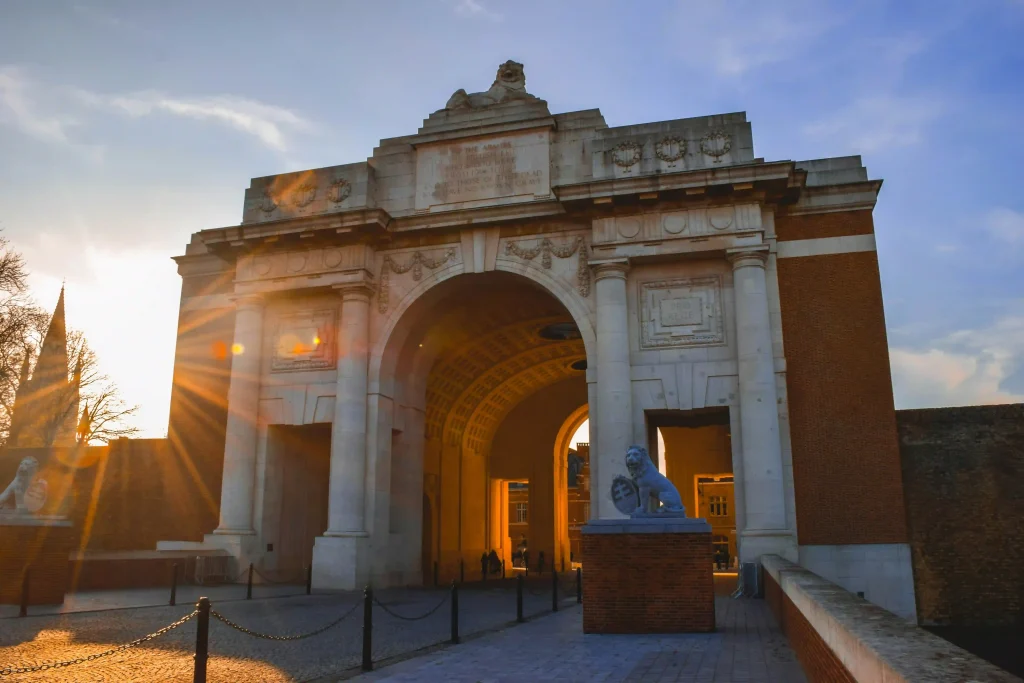
The Menin Gate isn’t a cemetery. It’s a memorial to the missing, and the missing here number 54,896. Every name carved into it belongs to a British or Commonwealth soldier who died in the Ypres Salient and was never found. For thousands of families, this wall is the grave.
The ceremony is short. Traffic stops under the arch, the buglers play, wreaths are sometimes laid, and about half an hour later it’s over. It’s free, it’s open to anyone, and it’s been happening since 1928. Get there by 7:30 pm if you want to stand close. In summer, or in the weeks around Remembrance Day, don’t bother fighting for a spot under the arch itself. Stand a few rows back. The sound carries, and the crowd falls quiet a full minute before the bugles begin.
Worth knowing
The ceremony has been interrupted once: the German occupation, 1940 to 1944. Even then it didn’t really stop, it moved to Brookwood Military Cemetery in England and carried on daily there. On 6 September 1944, the day Ypres was liberated, the buglers were back under the Gate. Same evening. There was still fighting within earshot of the town.
Check the Last Post Association before you go. They list the evenings when bands, choirs or wreath-laying groups take part. Expect noticeably bigger crowds on those evenings.
Inside the In Flanders Fields Museum
Do the In Flanders Fields Museum before the cemeteries, not after. Everything out in the fields makes more sense once you’ve been through it. The names, the headstones, even the flatness of the land reads differently.
The building alone tells half the story. The museum sits in the Cloth Hall on the Grote Markt, a medieval hall that was shelled to rubble during the war and then rebuilt, stone by stone, over decades. (If reconstruction stories like this one interest you, our guide to Belgium’s historic cities picks up the thread.)
Inside, the museum focuses on individual lives rather than military campaigns. Instead of presenting only battles and dates, it helps explain what the war meant for the people who lived through it. As you move through the galleries, you’ll find:
- Personal letters, diaries and photographs from soldiers and civilians.
- Interactive exhibits that follow individual stories throughout the war.
- Original artefacts recovered from the Ypres Salient.
- Audio and visual displays that place the fighting in its historical context.
Tickets are €12 for adults, plus a small extra for the Belfry tower. Usual hours are 10:00 am to 5:30 pm; from mid-November to the end of March the museum closes on Mondays. Hours move around with the seasons, so glance at the museum’s official site before you go.
Tyne Cot: the Largest of Them All
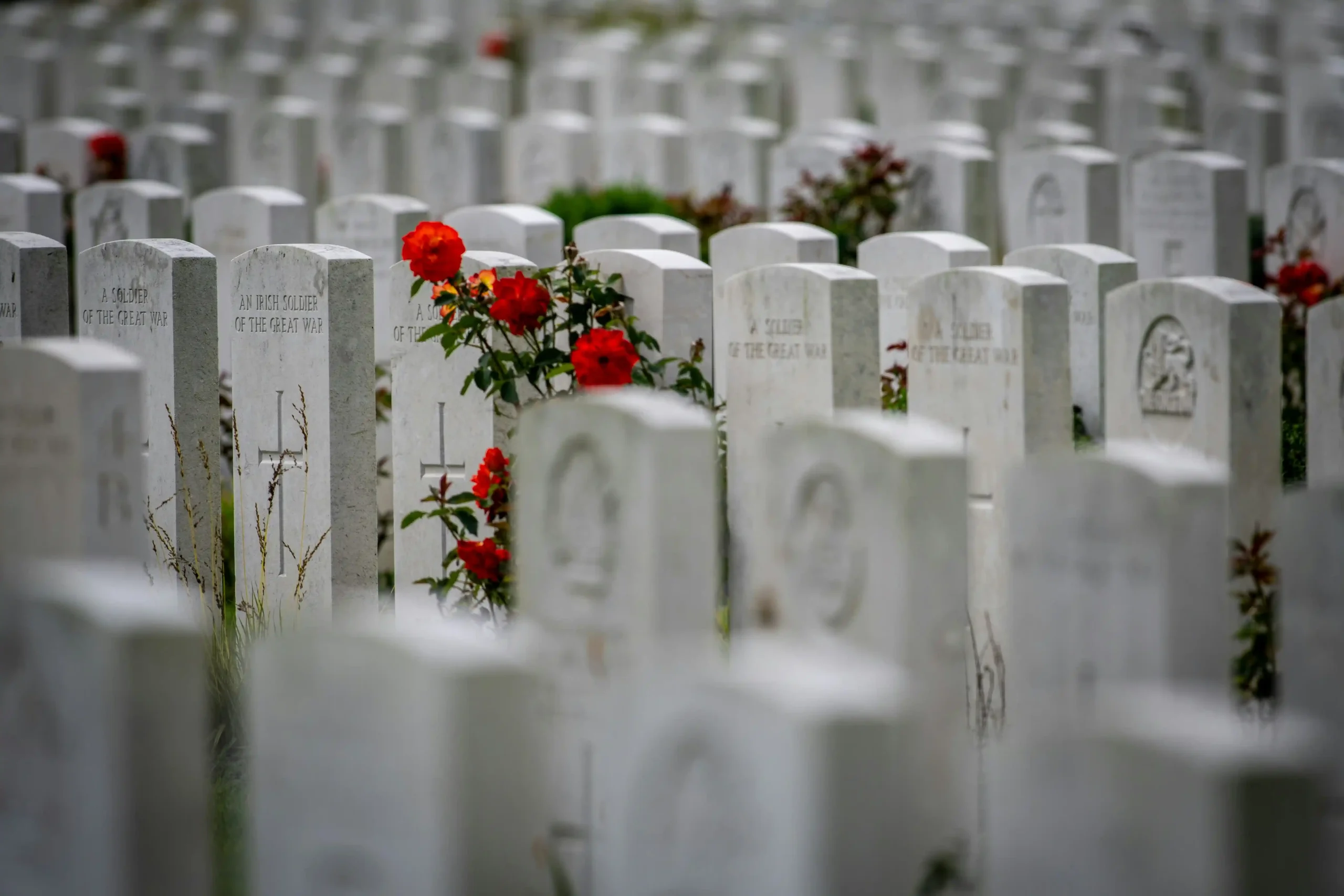
Nine kilometres northeast of town, near Passendale. Tyne Cot is the largest Commonwealth war cemetery in the world, and the numbers take a moment to absorb: 11,954 burials, more than 8,300 of them unidentified. The wall at the back carries another 34,957 names, men who died after 16 August 1917 and were never found at all.
I planned twenty minutes here. I stayed nearly two hours, and I wasn’t the only one having trouble leaving. There’s nothing to “do” at Tyne Cot. You just slow down, row after row, and keep meeting the same five words on stone after stone: A Soldier of the Great War, Known unto God.
Entry’s free. The visitor centre by the entrance is a good first stop. And if you don’t have a car, good news for once: this is the easiest site to reach, with buses from Ieper Markt running towards Passendale in around 20 minutes. Services change by day and season, so check the De Lijn journey planner before setting out.
Langemark and Essex Farm (the Other Stories)
Not every memorial here tells the same story. That’s the reason to see more than one.
Langemark German Military Cemetery
Langemark is the German military cemetery, and it’s the counterweight to Tyne Cot in every way. Dark granite instead of white stone. Markers flat to the ground, under oaks. More than 44,000 burials, including a mass grave with the remains of almost 25,000 men. See both cemeteries in one day and you’ll understand these fields better than any museum can manage. Bus 91 links Ieper Markt with Langemark in about 20 minutes; services are limited, so check the timetable before you leave.
Essex Farm Cemetery
Essex Farm is a few kilometres the opposite way, along the canal. The concrete dressing-station bunkers where McCrae wrote his poem are still there. You can walk through them, low ceilings and all. One grave here gets more visitors than any other: Valentine Joe Strudwick. Killed in 1916. Fifteen years old.
Now the catch. Tyne Cot is east. Langemark is north. Essex Farm is up the canal. Doing all three by bus in one day means arranging your visit around timetables instead of around the places, and this isn’t a place where you want to be watching the clock.
Finding a Name
For a lot of visitors, none of the above is really the point. The point is one person.
Start at home:
- search the CWGC database with a surname, regiment or service number. It returns the exact cemetery, plot, row and grave. No known grave? Then it gives you the memorial and panel number instead.
- Once you’re in town, the staff at the CWGC Information Centre will help with records and with working out how to reach the site.
- Every Commonwealth cemetery keeps a bronze box by the entrance with the register and a plan of the plots inside.
One thing to be ready for. If the record sends you to the Menin Gate or the Tyne Cot Memorial rather than to a grave, that’s the answer, not a mistake. For thousands of families, the carved name is the place.
Ten minutes of searching before you travel changes the entire visit. You arrive knowing exactly who you’re there for.
Planning Your Visit: One Day or Two
If your plan is to visit the Menin Gate and the In Flanders Fields Museum, you can comfortably explore both on foot. Adding Tyne Cot is also realistic, as it can be reached by bus from Ieper. Once you include Langemark and Essex Farm, however, the day becomes much more dependent on bus timetables and connections.
- Half a day: the Menin Gate and the museum, all on foot.
- A full day: add Tyne Cot by bus.
- Two days: now Langemark, Essex Farm and the smaller cemeteries fit too, without rushing any of it.
Bikes are an option people forget. Rentals in Ypres run €15 to €25 a day, the land is flat, and the riding is easy in dry weather.
If you’d rather not spend the day working around bus schedules, a transfer around the Ypres Salient solves the geography for you. One driver, your own order of sites, and as long at each place as you need. Some visitors want fifteen minutes at Langemark and two hours at Tyne Cot. Some want the reverse. That’s rather the point.
And if the Last Post is why you’re coming, decide in advance: either a night in Ypres, or a way home that doesn’t depend on the evening timetable. Ieper’s visitor information has current maps and practical updates.
After the Last Post
The Gate empties slowly after 8:30 pm. Evening journeys towards Brussels usually involve at least one change, and the options narrow as the night goes on, so check your connection before the ceremony, not after it.
Honestly, staying the night is the better ending. The town goes quiet once the coaches leave, and the walk back through the centre fits the mood of the evening. But if you’re leaving the same night, a driver waiting after the ceremony means you go when you’re ready. Not when the last connection says you have to.
FAQ
How do I get to Ypres from Brussels?
Train, about two hours, usually with a change at Kortrijk. Car or private transfer, around an hour and a half.
What time is the Last Post at the Menin Gate?
8:00 pm, every evening of the year, free. Arrive by 7:30, earlier in summer or around Remembrance Day.
Can you visit Tyne Cot without a car?
Yes. Buses from Ieper Markt take about 20 minutes. It’s combining Tyne Cot with Langemark and Essex Farm in one day that gets hard by bus; a bike, a tour or a private transfer works better for that.
How do I find where an ancestor is buried or commemorated?
The CWGC database, before you travel. It gives the cemetery and exact grave, or the memorial panel if there’s no known grave. At the cemetery itself, the register box by the entrance has a plan for the last few metres.
A Quiet Journey Home
Remembering is the purpose of the trip. Travelling doesn’t have to be the hard part. If it helps to have the practical side settled before you go, you can book your transfer to Ypres with Airport Taxis, and keep your attention on the places that brought you here.