
One Day in Ghent: 7 Places You Shouldn’t Miss
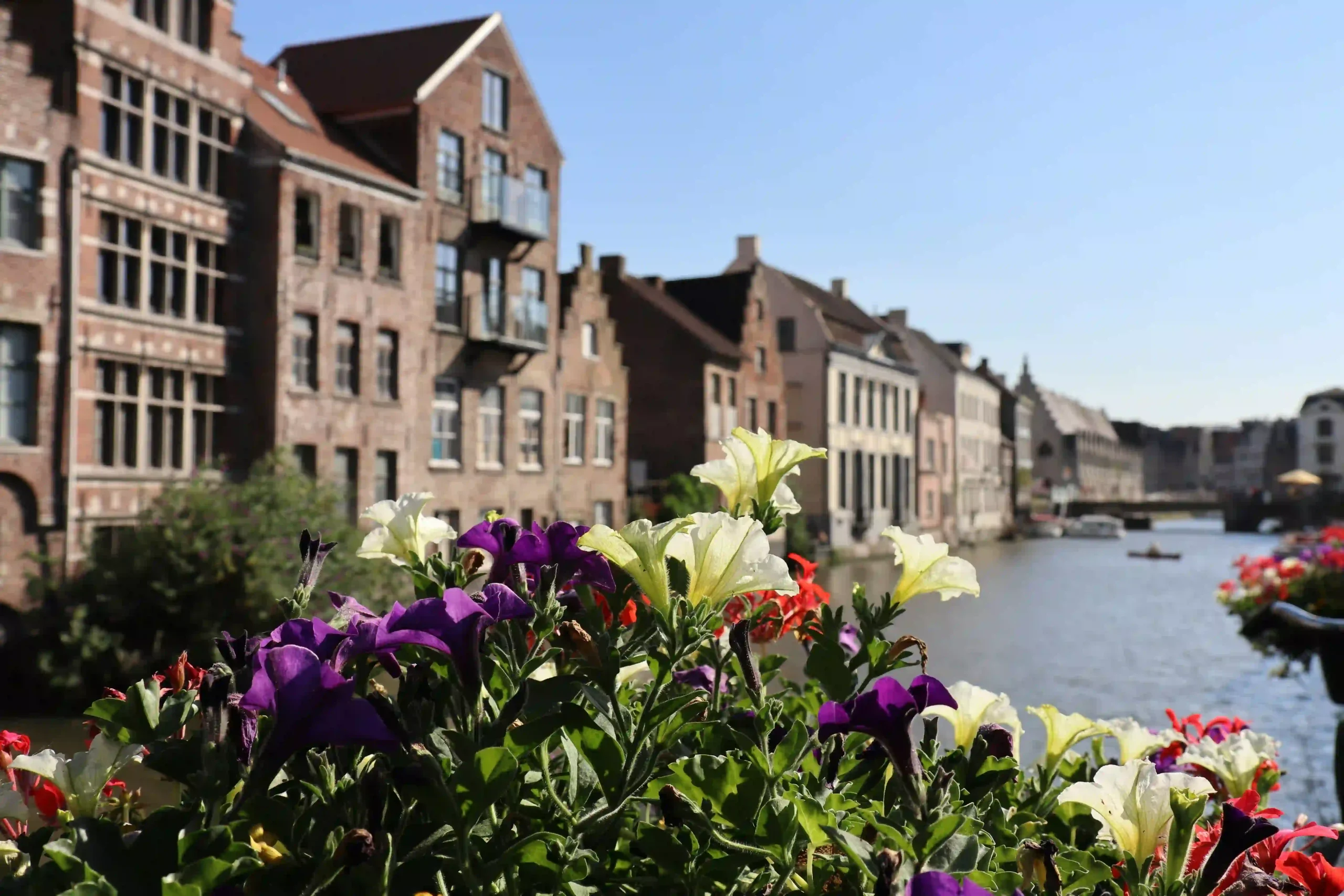
If you’re searching for the best things to do in Ghent, you’re about to discover what might be Belgium’s most underrated city. While Bruges attracts most of the crowds, Ghent quietly gets on with being a real, lived-in place. It has the canals, medieval towers and postcard views people travel across the world to see, but it also has students rushing to class, locals cycling to work and cafés that still feel like they belong to the city rather than to tourism.
I arrived expecting a smaller version of Bruges. Instead, I found a city with its own personality. One moment I was listening to church bells echo across the rooftops, the next I was eating a cuberdon by the canal while watching boats glide past centuries-old guild houses.
Now, let’s be honest. You won’t see everything in a single day. Ghent has far more to offer than seven attractions. Think of this guide as a menu rather than a checklist. Pick what sounds most like you and leave room for a slow coffee, a canal view and a few unexpected discoveries. The good news is that everything is surprisingly compact, easy to explore on foot and only around 30 minutes from Brussels.
Getting to Ghent
One of the best things about Ghent is how easy it is to reach. From Brussels, Belgian trains run frequently and take around 30 to 40 minutes to Gent-Sint-Pieters station. Coming from Antwerp? Expect roughly 50 minutes. From Bruges, it’s usually just 25 to 30 minutes. Before rushing out of the station, take a moment to look around. The main hall is decorated with murals representing 13 Belgian cities, which is a surprisingly nice welcome to Flanders.
From Gent-Sint-Pieters, the historic centre is about a 25-minute walk. If your legs are already tired from travel, tram line 1 gets you there in around 10 minutes. You can check schedules and tickets on the official Belgian rail website.
Flying into Belgium? Most visitors arrive via Brussels Airport (Zaventem), about 55 kilometres away, or through Charleroi Airport. If you’re carrying luggage, travelling with family or landing late, a pre-booked airport transfer to Ghent is often the simplest option. It takes the guesswork out of connections and gets you directly to your hotel. If you’re planning onward travel after your visit, it’s also worth checking out the best ways to reach the airport from Ghent.
One thing worth knowing before you rent a car: Ghent’s city centre is a Low Emission Zone. If your vehicle doesn’t meet the requirements, you could face a fine. Add expensive parking and limited spaces, and driving suddenly becomes much less appealing. That’s why many travellers choose the train or a fixed-price transfer instead.
Tip: If you’re planning to visit several paid attractions, keep the Ghent CityCard in mind. A quick bit of maths can save you more money than you might expect.
1. Step Inside Gravensteen, the Castle of the Counts
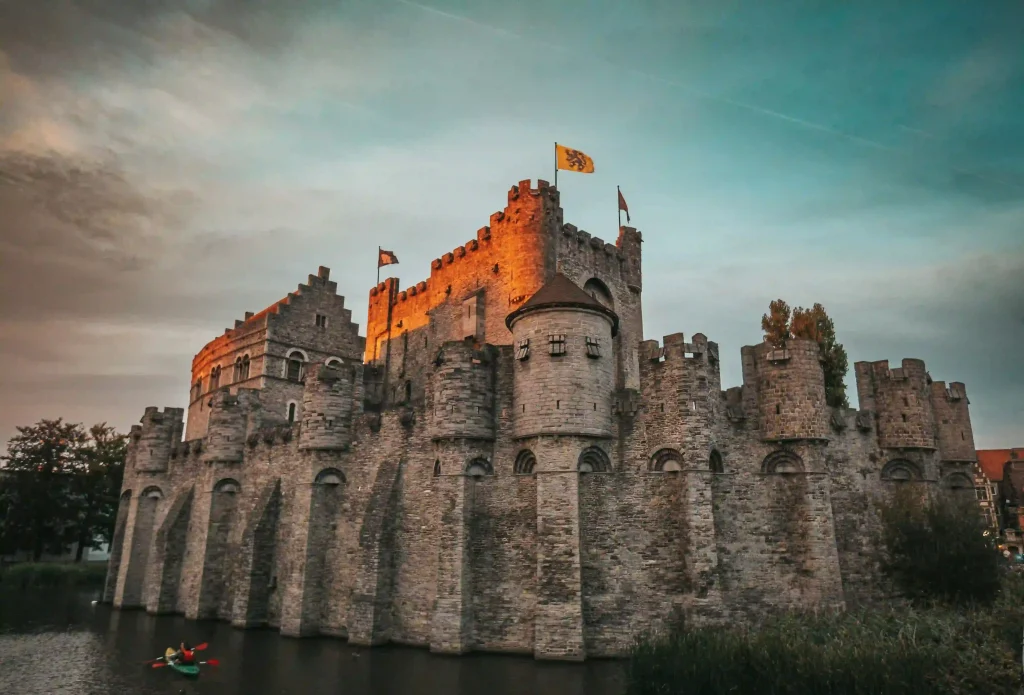
If you only have time for one paid attraction in Ghent, I’d make a strong case for Gravensteen. Rising above the city centre and surrounded by a moat, this medieval fortress has been watching over Ghent since 1180, when Count Philip of Alsace built it as a symbol of power. Over the centuries, it served as a fortress, a courthouse, a prison and, somewhat surprisingly, even a factory.
Inside, there is much more to explore than a quick castle walk-through. Highlights include:
- The armoury, with weapons and military displays from different periods.
- Former torture chambers and a collection of historical torture instruments.
- Reconstructed rooms showing how the castle was used through the centuries.
- The ramparts, where you can walk along the walls and enjoy a 360-degree view of Ghent.
- Views of the moat, one of the reasons Gravensteen remains one of the best-preserved medieval castles in Flanders.
Adult tickets cost around €13 (2026), and the castle is usually open from 10:00 to 18:00, although it’s always worth checking the latest opening hours before your visit.
Tip: Buy your ticket online in advance. During spring and summer, the queue at the entrance can be longer than you might expect.
Tip: Even if you don’t plan to go inside, walk around the castle first. The reflection of the stone walls in the surrounding water creates one of the best photo spots in Ghent.
Tip: Make time for the ramparts. Many visitors agree that the panoramic city views are the real highlight of the castle.
One funny detail: the torture chamber often ends up being the unexpected favourite part for children. Apparently, medieval history becomes much more interesting when it gets slightly creepy.
2. Climb the Belfry for the Best View in Ghent
If Ghent had a viewing platform for understanding the city at a glance, this would be it. The Belfry of Ghent (Belfort van Gent) rises 91 metres above the streets and has watched over the city since the 14th century. It’s the tallest belfry in Belgium and part of the UNESCO-listed collection of historic belfries across Flanders.
The tower is also one of Ghent’s famous “three towers”, standing alongside St Bavo’s Cathedral and St Nicholas’ Church. For centuries, it wasn’t just a landmark. Important city charters were stored here, and the tower served as a lookout point protecting the city. Its most famous bell, Klokke Roeland, became a symbol of Ghent’s independence and pride.
Today, most visitors come for one thing: the view.
What makes the Belfry worth visiting?
- A 360-degree panorama across Ghent’s rooftops, canals and church spires.
- A chance to see the city’s famous three towers from above.
- Historic exhibits explaining the tower’s role in medieval Ghent.
- An elevator to the upper levels, which is surprisingly rare in historic towers.
- One of the best photo opportunities in the city.
Adult admission is usually around €8 to €10 (2026), making it one of the most affordable viewpoints in Belgium. For current opening times and visitor information, check Visit Gent before you go.
Tip: There is a lift, so you don’t need to tackle endless stairs to enjoy the view.
Tip: Save the Belfry for a clear day if possible. Ghent’s skyline is beautiful, but much of the magic disappears into the clouds when the weather turns grey.
Tip: Visit in the morning. Not only is the light often better for photos, but you’ll usually share the viewing platform with far fewer people.
And yes, after your third medieval tower of the day, you may think, “Surely another tower can’t be that different.” Then you get to the top and spend the next ten minutes pointing at rooftops like an excited child.
3. See the Mystic Lamb at St Bavo’s Cathedral
St Bavo’s Cathedral is one of those places where you walk in for “just a quick look” and somehow lose half an hour staring upward. The Gothic interior is grand, calm and full of detail, and entrance to the cathedral itself is usually free. But the real reason many visitors come here is the Ghent Altarpiece, also known as the Adoration of the Mystic Lamb.
Created by the Van Eyck brothers in the 15th century, this polyptych is one of the great masterpieces of early Renaissance art. It also has the kind of backstory that sounds almost too dramatic to be true. It was stolen by the Nazis, hidden on Hitler’s orders in a salt mine and rescued in 1945 by the Monuments Men. Not bad for an artwork that now sits quietly inside a cathedral.
There is one important update for your visit. The final phase of restoration is ongoing until spring 2027. During this period, seven panels in the cathedral are temporarily replaced by high-quality photographic copies. If you want to see the original upper-register panels, go to the Museum of Fine Arts (MSK). On weekdays, you can watch restorers at work, while on weekends, the panels are displayed for visitors.
What to know before you go:
- Entry to St Bavo’s Cathedral is usually free.
- The Mystic Lamb visit costs around €12.50 for adults.
- The AR experience costs around €16 and is worth considering.
- Online booking is required for the altarpiece visit.
- Opening hours for the altarpiece centre are usually Monday to Saturday, 10:00 to 17:00, and Sunday, 13:00 to 17:00.
- CityCard Gent gives a €10 discount on the altarpiece visit.
Tip: Book your ticket online before you go. This is not the place to arrive casually and hope for the best, especially on weekends.
Tip: If seeing the originals matters to you during the restoration period, add MSK to your plan. The cathedral is still essential, but it is not the full story right now.
Tip: Choose the AR tour if you like context. It is less “dry museum audio guide” and more “medieval art suddenly makes sense”.
Tip: If you are buying the CityCard Gent, remember the €10 discount here. It can change the maths quickly if you are visiting several paid attractions in one day.
4. Wander Graslei and Korenlei, the Medieval Waterfront
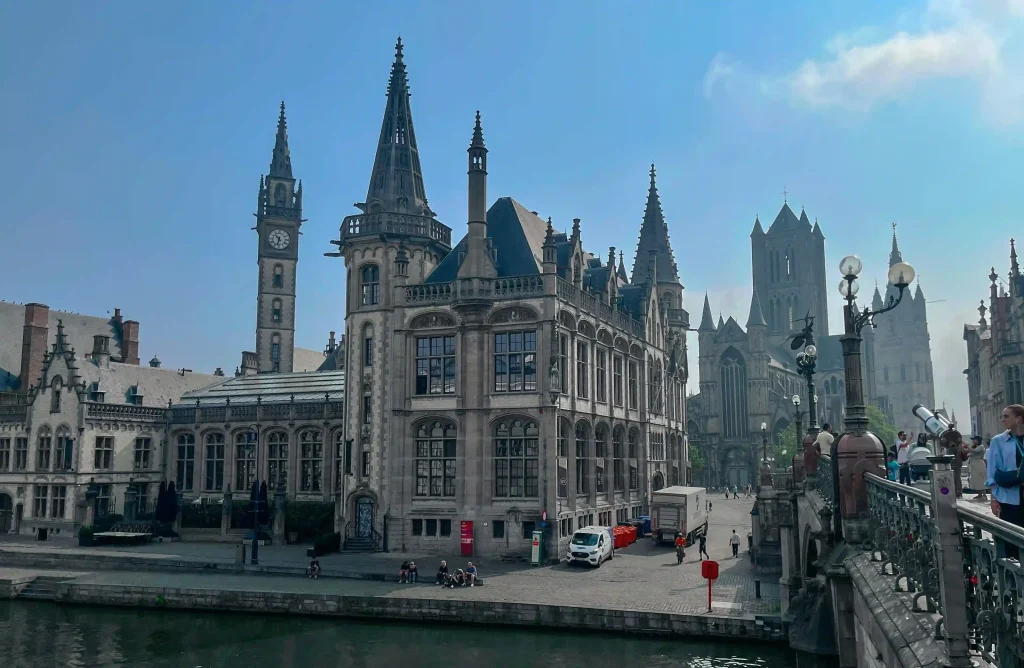
If someone asked me to show them one postcard-perfect corner of Ghent, I’d bring them straight to Graslei and Korenlei. These two historic quays stretch along the River Leie in the heart of the old city and are lined with beautifully preserved guild houses dating from the 12th to 17th centuries. This is the Ghent you see on travel posters, but somehow it feels even better in person.
What I love most is that the area isn’t just beautiful. It still feels alive. Students sit by the water after class, locals meet friends for a drink, and visitors drift from one photo opportunity to the next. It’s one of the few places where medieval architecture and everyday city life blend so naturally.
Things not to miss:
- The historic guild houses reflected in the River Leie.
- The lively waterfront atmosphere throughout the day.
- St Michael’s Bridge (Sint-Michielsbrug), which offers the best view of Ghent’s famous three towers.
- Canal cruises departing from the quays.
- Some of the most photogenic streets and viewpoints in the entire city.
For more information about the area, walking routes and canal cruises, check Visit Ghent’s official site.
Tip: Come back around sunset if your schedule allows. As the evening light hits the old façades, the waterfront becomes even more beautiful.
Tip: Grab a coffee, a local beer or a snack and sit on the steps by the river. It’s one of the cheapest and most enjoyable experiences in Ghent.
One small warning: roughly 90% of your Ghent photos will probably be taken here. Make sure your phone is charged before you arrive.
5. Eat Your Way Through Ghent: Cuberdons, Waffles, Chocolate
One of the nicest surprises on my Ghent day trip was how much of the city can be experienced through food. Between the medieval buildings and canal views, there is always something worth tasting. And unlike some tourist-heavy destinations, Ghent still feels like a city where locals actually eat in the centre.
The snack you absolutely shouldn’t leave without trying is the cuberdon, known locally as a neuzeke (“little nose”). These purple cone-shaped sweets have a firm outer shell and a soft raspberry-flavoured filling that almost spills out when you bite into them. You’ll find them sold from traditional stalls, particularly around Groentenmarkt, where two rival cuberdon vendors have become something of a local legend.
Beyond sweets, Ghent rewards curious eaters.
What should you try?
- Fresh cuberdons from a street stall.
- Belgian waffles from a local bakery or café.
- Traditional chocolates from historic shops such as Confiserie Temmerman.
- Tierenteyn-Verlent mustard, a Ghent institution with a history stretching back generations.
- Vegetarian dishes that reflect the city’s progressive food culture.
Ghent is often considered Belgium’s vegetarian capital. The city became famous for introducing Donderdag Veggiedag (Vegetarian Thursday), and you’ll find far more plant-based cafés and restaurants here than in many other Belgian cities.
Tip: Buy a fresh cuberdon from a market stall rather than a souvenir shop. The texture is completely different, with a softer, more liquid centre.
Tip: If you’re vegetarian, Ghent is one of the easiest cities in Belgium to eat well. Many cafés and restaurants offer genuinely creative plant-based menus.
Tip: Be careful around the busiest tourist squares when buying waffles. A short walk down a side street often leads to better quality and lower prices.
Tip: Don’t try to squeeze all your meals into one. Ghent is a city made for grazing. A cuberdon here, a waffle there, a piece of chocolate later, and suddenly you’ve had a very successful day.
And yes, buying chocolate “for friends back home” is a perfectly acceptable excuse. Whether any of it actually survives the journey is another question.
6. Discover Ghent’s Quirky Side: Street Art and the Dr Guislain Museum
After a few hours of castles, cathedrals and medieval towers, I found myself craving something completely different. That’s one of the reasons I like Ghent so much. Just when you think you’ve figured the city out, it throws a colourful graffiti tunnel or a museum about the history of psychiatry into the mix.
The easiest place to start is Werregarenstraat, better known as Graffitistraat (Graffiti Street). Hidden in the city centre, this narrow alley is one of the most colourful spots in Ghent. Unlike most cities, where graffiti appears despite the rules, here it is actively encouraged. Artists are free to paint over existing works, which means the street is constantly changing. Visit twice in the same year and you’ll probably see a completely different wall.
For travellers who enjoy unusual museums, the Dr Guislain Museum offers something far beyond the standard sightseeing circuit. Located in a former psychiatric asylum dating from 1857, it explores the history of mental health care through thought-provoking exhibitions. It’s one of those places that stays with you long after your visit.
A few reasons to add this side of Ghent to your itinerary:
- Werregarenstraat is completely free to visit.
- The artwork changes regularly, making every visit unique.
- Ghent has one of Belgium’s strongest street art scenes.
- The city even provides an official street art map.
- Dr Guislain offers a very different perspective on Belgian history and culture.
Tip: Don’t rush through Graffiti Street. Take a slow walk and look closely. Some of the smaller pieces are more interesting than the giant murals.
Tip: Pick up the official street art map from the tourist office and turn your walk through Ghent into a treasure hunt.
Tip: If you’ve already seen enough churches and towers for one day, Dr Guislain is a refreshing alternative that most visitors completely miss.
Tip: Visit Graffiti Street at different times of day if you’re nearby. Changing light can make the colours look surprisingly different.
And if you’re wondering whether a graffiti alley and a psychiatry museum belong on the same sightseeing list, welcome to Ghent. That’s exactly the kind of city it is.
7. Drink Like a Local: Ghent’s Beer Culture
You don’t have to be a beer expert to appreciate Ghent’s pub culture. In Belgium, beer is less of a drink and more of a national pastime, and Ghent takes that tradition seriously. The city is full of cosy bars where locals gather after work, students linger for hours and visitors quickly discover that Belgian beer is often much stronger than it looks.
What I like most is that every bar seems to have its own personality. Some feel like living museums, others focus on modern craft brewing, and a few embrace the city’s slightly eccentric sense of humour.
If you’re not sure where to start, these are some of Ghent’s best-known beer spots:
- Dulle Griet, famous for its giant Max beer and the unusual tradition of leaving a shoe as a deposit for the glass.
- Waterhuis aan de Bierkant, a historic waterfront pub housed in a former brothel.
- Trollekelder, the “troll bar” with more than 200 Belgian beers on offer.
- Dok Brewing Company, a modern microbrewery located in the old port area.
More than the beer itself, what people often remember is the feeling of gezelligheid, that uniquely Belgian sense of warmth, comfort and good company that is difficult to translate but easy to recognise when you experience it.
Tip: If you order the famous Max beer at Dulle Griet, don’t be surprised when you’re asked to hand over a shoe. It’s all part of the tradition, and yes, you’ll get it back.
Tip: Not a beer fan? Ghent also has excellent cocktail bars, including The Cobbler, as well as plenty of independent coffee shops.
Tip: Belgian beer is often much stronger than standard lagers. An 8% beer is completely normal here, so pace yourself if you still have sightseeing left to do.
Tip: If you’re visiting in the evening, consider stopping for one drink rather than turning it into a full night out. Ghent is especially beautiful after dark, and a relaxed walk along the illuminated canals is hard to beat.
Let’s just say that after two Belgian beers, many visitors suddenly become very confident about their ability to pronounce Dutch place names.
Save Money with the Ghent CityCard
If you are planning a busy Ghent day trip, the CityCard Gent is worth a quick calculation. In 2026, the 48-hour card usually costs around €42 to €45, while the 72-hour version is around €48 to €50. That may sound like a lot for one day, but the numbers can add up quickly.
Here is the simple maths: Gravensteen costs about €13, the Belfry around €9 and a canal cruise roughly €10. Add public transport and the €10 discount on the Mystic Lamb visit, and you are already getting close to the price of the card.
Tip: If you plan to visit three or more paid attractions, the CityCard often makes sense. If you only want one museum, a walk by the canals and a beer, buy separate tickets and spend the savings on waffles.
Which Ghent Experience Is Right for You?
The nice thing about Ghent is that there isn’t a single “correct” way to spend your day. The city is compact enough that you can mix and match depending on what interests you most.
- For history and architecture lovers: Start with Gravensteen, climb the Belfry and spend time wandering around Graslei and Korenlei. This combination gives you medieval Ghent at its best.
- For art enthusiasts: Make the Mystic Lamb your priority and, if you’re visiting during the restoration period, add the Museum of Fine Arts (MSK) to see original panels and restoration work up close.
- For foodies and atmosphere seekers: Sample fresh cuberdons, hunt down great chocolate, find a good waffle and finish the day in one of Ghent’s traditional beer bars.
- For travellers who prefer the unexpected: Explore Werregarenstraat, follow the city’s street art trail and visit the Dr Guislain Museum for a side of Ghent that many tourists never discover.
My advice? Don’t try to do all seven. Pick three or four experiences that genuinely interest you and leave some time for a coffee by the canal. Ghent is one of those cities that rewards slowing down.
Getting to Ghent Without the Stress
A day trip to Ghent is surprisingly easy once you’re in Belgium. The city is compact, walkable and well connected to Brussels, Bruges and Antwerp. The part that deserves a little extra planning is getting there from the airport or deciding whether to drive into the city centre.
Because Ghent operates a Low Emission Zone and parking in the historic centre can be both expensive and limited, many visitors find that public transport or a direct airport transfer is the simpler option. If you’re arriving at Brussels Airport or Charleroi with luggage, travelling as a family or landing after a long flight, a fixed-price transfer straight to Ghent removes the hassle of connections, parking searches and LEZ concerns.
If you’re still planning the wider journey to Belgium, our guide on how to reach Belgium from London can help you compare the most practical travel options before you arrive.
Whatever itinerary you choose, Ghent rewards a little preparation. Sort out the journey in advance, then spend your day enjoying castles, canals, chocolate and great views instead of worrying about transport.
FAQ
How far is Ghent from Brussels?
Ghent is about 55 kilometres from Brussels. By train, the journey usually takes around 30 to 40 minutes, with frequent connections throughout the day. By car, it normally takes about one hour, but remember that Ghent’s city centre has a Low Emission Zone, so driving in requires a little extra planning.
Is Ghent worth visiting?
Yes, Ghent is absolutely worth visiting. It has many of the things to do in Ghent that people love about Bruges, including canals, medieval towers and historic streets, but with fewer crowds and a more lived-in student-city atmosphere. Add great food, local beer, and a compact old centre, and it becomes one of Belgium’s best day-trip cities.
How many days do you need in Ghent?
One day in Ghent is enough to see the main highlights if you choose three or four key stops, such as Gravensteen, the Belfry, Graslei and the Mystic Lamb. If you enjoy slower travel, staying overnight is even better, especially because the canals and historic buildings look beautiful after dark.
How do I get from Brussels Airport to Ghent?
You can travel from Brussels Airport to Ghent by train, usually with a connection via Brussels. If you have luggage, arrive late or want to avoid transfers, a fixed airport transfer directly to the city centre is the more comfortable option. It also helps you avoid dealing with the Low Emission Zone and parking in central Ghent.
Planning a Day Trip to Ghent?
If you’re flying into Belgium, a little planning goes a long way. A direct airport transfer can get you from Brussels Airport or Charleroi straight to Ghent without train changes, parking worries or dealing with the city’s Low Emission Zone.
If you’d rather spend your time exploring than figuring out transport, book your airport transfer to Ghent and enjoy a direct ride from the airport to Ghent.